

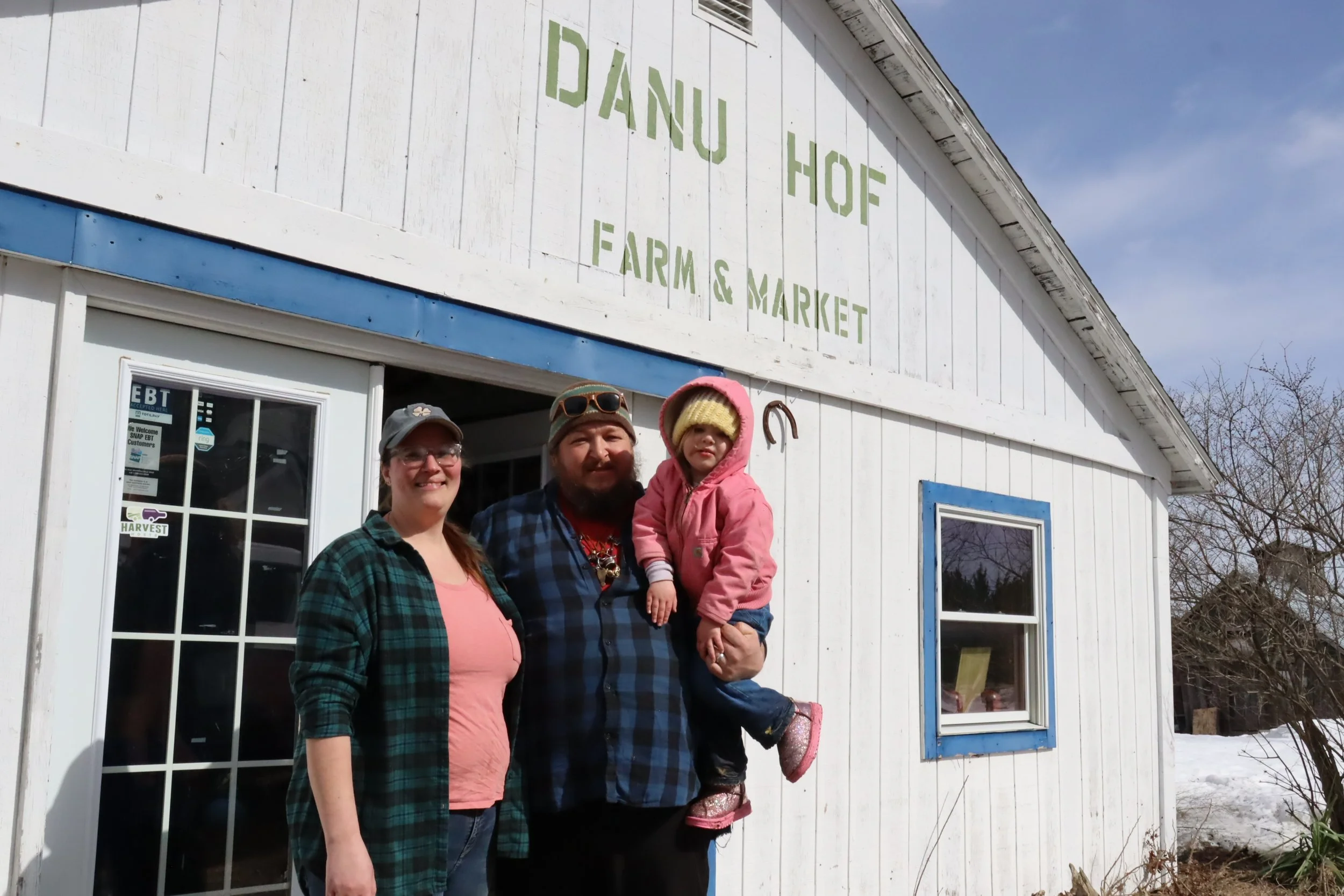
Danu Hof Family | Photo Credit: Xavier J.
Behind every farmers market table is a story most people never hear
There are some places that feel quiet when you arrive, but not because nothing is happening. They feel quiet because everything is happening.
That was Danu Hof.
Snow still sat high on parts of the property when we visited. Paths had been carved through it. The hoop house held that early kind of spring hope only farmers seem to recognize right away. Inside, there was cabbage planted, talk of spinach and Swiss chard and radishes, and the familiar rhythm of people already thinking weeks and months ahead, even while winter still hadn’t fully let go.
Danu Hof is a family farm in Northern Michigan rooted in food, land, and community. As they shared in their written responses and in-person interview, their goal has always been to create a place that connects people more closely to both their food and the land it comes from. The name itself reflects that intention: “Danu” comes from Celtic tradition and represents the mother goddess of agriculture, while “Hof” is the German word for farm. The farm has grown step by step, learning as they went, building relationships, and raising pasture-based meats, eggs, and seasonal produce for families across the region.
And like so many farms, their story is not just about what they grow.
It is about what it takes to keep growing at all.
The question that changed the conversation
At one point during our visit, the conversation turned to the question sitting underneath so much of what they are facing right now:
Why would a small farm even consider purchasing a poultry processing plant?
The answer came quickly, and with the kind of weight that tells you this has been sitting heavy for a long time.
The last poultry processing access point in Northern Michigan closed last March.
That one closure changed the math for everyone.
Now, if a farmer wants to legally sell chicken at a farmers market, to a grocery store, or to a restaurant, the closest option is downstate, roughly four and a half hours away. That means waking up at two in the morning, loading live birds, driving down, waiting through same-day processing, hauling everything back safely in separate coolers, and losing an entire day on the
farm in the process.
And even if a farm does all of that correctly, the numbers still do not work.
When they ran the cost, it came out to around $17 per pound just to cover the mileage and drive time.
That is not a price most customers can absorb.
And it is not a loss small farms can afford to quietly eat.
Their questionnaire put it plainly: “Access to poultry processing has become one of the biggest challenges for small farms in our region.”
That is the deeper story here.
This is not just a farm project.
This is infrastructure.
What “local food” actually asks of a farmer
People love the phrase local food.
They love the finished version of it. The market table. The clean package. The farm stand. The feeling of buying something grown nearby.
What gets missed is the chain of effort behind it.
In their written answers, Danu Hof said they wish more people understood “the amount of work, planning, and knowledge that goes into producing food.” Farming is not planting something and waiting. It is weather patterns, soil health, animal care, harvest timing, regulation, transportation, and the constant problem-solving required to get food to someone’s plate. They also described farmers as “environmentalists… the boots on the ground, working directly with the land every day.”
You could hear that same truth all through the audio.
There was a conversation about frost differences within five miles. About trying to learn from books and videos made in places like North Carolina, Ohio, California, etc., only to realize that the advice doesn’t apply cleanly in Northern Michigan. About how a farm on one hill can stay warmer, while another farm just a few miles away gets hit with a hard frost in May.
That kind of farming knowledge does not come from aesthetics.
It comes from time. Mistakes. Observation. Repetition. Community.
And often, it comes from learning with far less support than people assume exists.
“Just start” — but start honestly
One of the strongest written answers in the questionnaire was also one of the simplest:
“Just start—at whatever level you can.”
That answer matters because it cuts through the myth that farming has to begin with hundreds of acres and a perfect blueprint. Their response continues by saying that farming might begin with a window box, a backyard garden, or a few chickens, and that “one of the biggest lessons… is letting the land help shape the idea, rather than trying to force an idea onto the land.” They also emphasized something people do not say enough: you need to be financially prepared.
That same honesty carried into the interview.
When asked what they would do differently, one answer was immediate: an electric fence. Years of wasted fencing, wasted time, and lessons learned the hard way.
Farming was never meant to be done alone
One of the clearest themes in both the audio and questionnaire was that farming works best when it is relational.
In the interview, they talked about carrying apples from another farm because not every farm needs to grow apples. Later they talked about carrying honey and maple syrup from older producers, helping neighbors stay in the market without having to physically do every market themselves.
They spoke about how local farms need to stop competing and start thinking collectively.
That shows up in their written answers too:
“Farming isn’t just about growing food—it’s about building a community around that food.”
Relationships are not extra in farming.
They are a community & survival..
The gap between production and access
One of the strongest ideas from the questionnaire is that one of the biggest problems in local food is not always production — it is access.
They wrote: “Many small farms are capable of producing high-quality food, but the infrastructure… often isn’t designed with small farms in mind.”
They also named the knowledge gap:
“Many people want to buy local food but aren’t always sure where to find it, how to cook it, or how to adapt to seasonal availability.”
That point came alive over and over again during the visit.
Farmers are not just growing food anymore.
They are translating the food system.
Why gastronomy belongs in this story
“To me, gastronomy is really about reconnecting people with food.”
They spoke about lost skills—cooking from scratch, preserving food, and understanding seasonality.
And one of their favorite meals?
“A BLT made with fresh local tomatoes, local bacon, and good sourdough bread… when ingredients are fresh and grown well, they don’t need much.”
The paperwork people never see
There was a point in the interview where the conversation shifted into something so many people overlook: paperwork.
Binders upon binders.
Records for irrigation, manure, water, animals, produce, equipment, and compliance.
Winter is not downtime.
It is survival work.
The future of local food depends on what we normalize now
“Local farms are part of the backbone of rural communities.”
They continued:
“Supporting local farms keeps food, dollars, and stewardship rooted in the community.”
And the new processing plant DONATE HERE —> https://gofund.me/166223f40
“A local processing facility… becomes shared infrastructure that helps multiple farms grow and bring food to market.”
How people can help
“The biggest thing people can do is support farms year-round.”
“Support can also mean sharing our story… Those connections are what keep farms going.”
And maybe that is where real support begins.